
Why utilisation monitoring?
Utilisation monitoring gives you a clear, data-rich view of every desk, room, building and portfolio. Armed with real data, you can make confident decisions that:

Identify underused or vacant rooms

Reconfigure or consolidate services

Unlock opportunities to deliver more patient care

Support bids and business cases with real evidence

Reduce costs and realise the value of your estate
NHS spaces are often used less than 40% of the time
Our utilisation monitoring shows that rooms often sit empty, even when buildings feel busy.
Download the brochure to learn more about:
- How NHS Open Space can provide the full picture of your estate — from daily activity levels to occupancy patterns
- How we can help you make informed, data-driven decisions that unlock value and support long-term strategic planning.
What we help you achieve

Estate-wide visibility
at desk, room, building and portfolio level

All-in-one utilisation reporting
for demised, bookable and vacant space

Behavioural and trend insights
understand patterns of use, peak demand, and no-shows

Evidence-based recommendations
drive occupancy, consolidate, repurpose, or dispose of surplus space
Real insight. Real savings. Real results.
Sudbury Community Health Centre, located in Suffolk, serves a growing population with a blend of clinical and non-clinical services. The local Integrated Care Board (ICB) sought to understand whether there was space for an additional GP, or whether an extension was required.
A three-month utilisation study revealed 36.7% overall utilisation — with 40% of rooms vacant even at peak times and identified 35 rooms with less than 45% usage.
The result? A £1.5m cost saving due to the extension not being needed, as the incoming GP could be accommodated within the existing footprint.
Across the Outpatients Department (OPD) and Ranken House, Queen Elizabeth Hospital — a major NHS facility in Woolwich, southeast London — was facing challenges with underutilised clinical and non-clinical spaces, prompting a need to identify opportunities for improved space efficiency and service delivery.
A utilisation study revealed that the OPD had a 53.6% utilisation rate. Ranken House averaged 34.7% utilisation, with every room under 60% and 21 rooms below 30%. Only 90 of 236 desks were in use on a typical day.
We recommended consolidating services in the OPD, moving non-clinical teams to Ranken House, and adopting hybrid working.
57–59 Bath Road, in Reading, is a modern, three-storey office building owned by NHS Property Services. It accommodates a mix of NHS and private sector tenants.
Before Berkshire Healthcare Foundation Trust (BHFT) could start operating services from the ground and first floors, it was essential to understand how the space was currently being utilised to see if any reconfiguration was required.
A six-week utilisation study revealed the building averaged 7.1% utilisation. The ground floor 3.6%, and the first floor 9.6%. At peak, only 19 desks were in use.
We proposed relocating current users to the second floor, freeing up space for BHFT to deliver clinical services.
From ongoing utilisation monitoring across NHS Property Services' national portfolio, NHS Open Space has helped double utilisation over the last five years, from 19% to 41.2%.
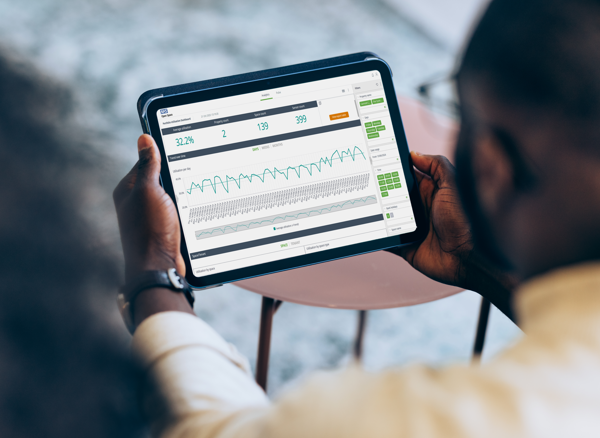
Which is right for me?

Utilisation study
A time-bound study, typically used to answer a specific question or questions about your estate utilisation.

Ongoing monitoring
Continuous monitoring enables you to understand your estate utilisation over time and track optimisation initiatives.
Not sure?
We're here to discuss your challenges and suggest the best solution for you. Get in touch
Hear from our experts
In this video, Christopher King, Head of NHS Open Space, and Rajiv Tyagi, Business Management Partner, detail the benefits of utilisation studies and ongoing monitoring.
Speak to our teamFlexible, affordable options
A utilisation study is quick, non-intrusive, and highly cost-effective. Prices start from:
- Ten rooms for as little as £2,000
- One hundred rooms for just £5,000
- Potential savings of hundreds of thousands — even millions — through better use of space
As part of the NHS, every penny we get is reinvested across the NHS to transform the national estate. We're not here for profit. We exist to make the system work better — for you and for patients.
POA for utilisation monitoring.